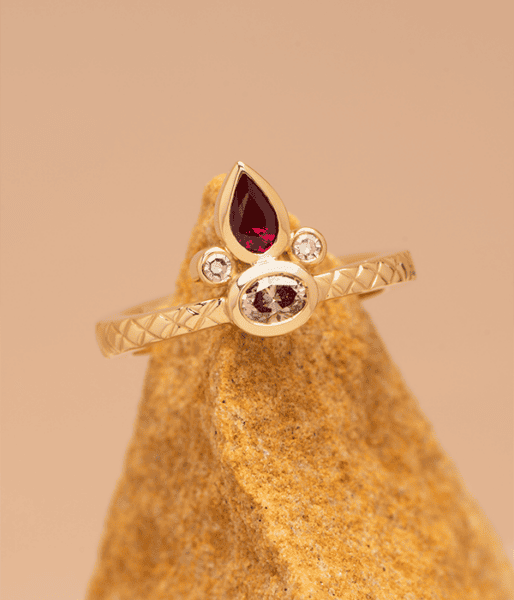
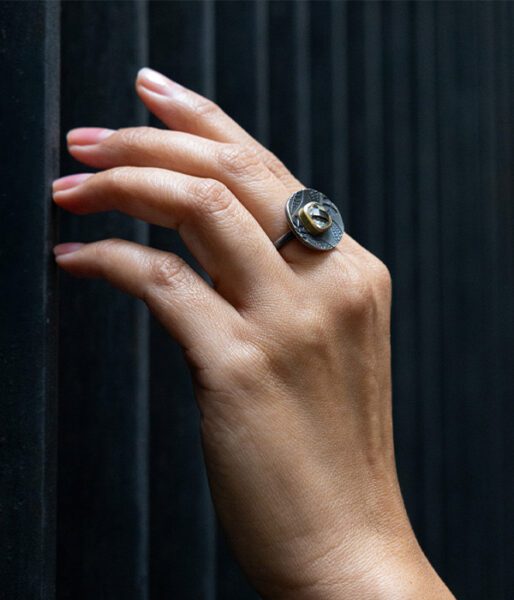
Introducing Gabbee Stolp
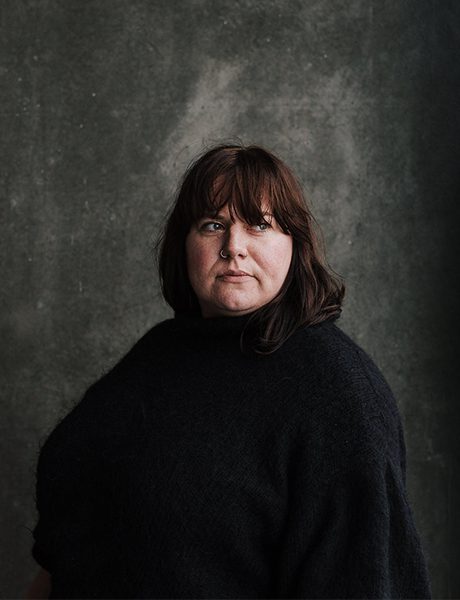
Gabbee Stolp is our first new artist to join the e.g.etal in 2026, with a shimmering collection that celebrates the preciousness of the natural world itself.
Inspired by the world around her, Gabbee’s work examines material, memory, and place, evoking themes that include grief, loss, and human-induced extinction. Through her practice, she creates gentle tools through which we can reflect upon time, change and the way our lives are invariably connected to the deep history and ecology of the places we live.
Ahead of her launch, Gabbee let us into her world to discuss her practice and the inspiration behind a body of work that brings softness to the fore with equal parts tenderness and playfulness.
How would you describe your aesthetic?
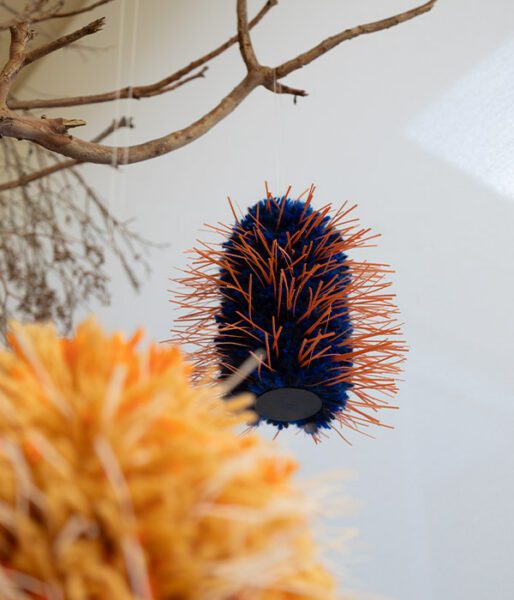
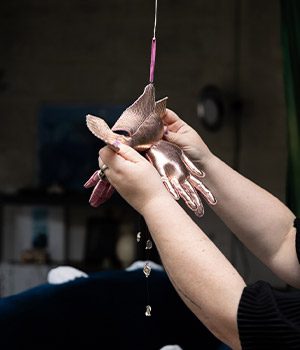
I use luxuriously tactile, colourful textiles in my work to create pieces that embody an aesthetic of softness, which carries with it ideas of gentleness, warmth and nurturing.
I think we often overlook softness as a valuable trait in our human-ness, and I think the world could use more softness, gentleness and nurturing. I use shimmering metallic textiles in gold and silver, alluding to the preciousness of gold and silver. By incorporating these shimmering textiles with natural materials like shells, I create jewels that highlight the preciousness of nature itself.
What made you want to become a jewellery artist? What led you to this point in your career?
I have always been creative; it is something that my very creative parents and family nurtured in me from a young age. I failed art in high school, and my practical brain decided to become a nurse, but in my early 20s, big changes in my life pushed me back onto a creative path.
I was drawn to jewellery-making because I like the intimacy of its scale and its connection to our bodies and our personal stories and histories. I studied jewellery design at TAFE in Tasmania and then went on to study Fine Arts/Gold and Silversmithing at RMIT University in Melbourne. I returned to Lutruwita/Tasmania in 2018 and continued to make and exhibit work here and abroad.
In 2020, I co-founded State of Flux Workshop, a collaborative workspace and gallery for contemporary jewellery in Nipaluna/Hobart. I now balance my life between work as a rural community nurse and working creatively in my studio at State of Flux and at home in the Derwent Valley. For me, being creative is a medicine, a form of meditation, a compulsion, and my language.
What influences you and inspires you?
I am primarily influenced by my care and concern for the world around me. This excerpt from a piece I wrote for Island Magazine at the end of 2025 answers the above pretty well:
“There is definitely a strong element of connection to nature as the inspiration for my work. I often make work about watery places, our human relationship with these places, and the creatures that live within and alongside them. Bodies of water signify life, connection and transformation. They hold memories, they tell us of deep history and of constant change. We carry water within our own bodies. A lot of my current work is informed by a particular body of water that holds personal importance to me: Timtumili Minanya/the River Derwent. The river runs through the town in which I live; a small but precious view of it was a well-loved feature of my childhood home. My mother’s ashes are scattered in this river. I find comfort and relief swimming in its dark waters, and I collect shells from its ever-changing banks. I try to honour the river in my work and acknowledge its importance, far beyond my own life.”
 How do you approach making new work?
I collect many of the shells I use myself. The shells are often collected from the estuarine beaches of Timtumili Minanya/the River Derwent in Nipaluna/Hobart, and they are also sometimes collected further afield around Lutruwita/Tasmania. Sometimes I am gifted pieces found by friends, and sometimes I even chance upon old shell collections that are no longer wanted.
Because of the unpredictability of access to these found materials, the work is quite often guided by the materials I have at hand. I am interested in their forms (sometimes whole, sometimes broken) as well as the stories attached to the places from which they have come. When making figurative works, I am drawn to those creatures that are vulnerable, especially to the impacts of human activity. Often, the creatures I am drawn to are the ones that seem hidden or unattractive, the underdogs. In making them, I am hoping to shine a light on their value.
What are your favourite materials to work with and why?
I love to work with textiles in particular. I love the ideas of softness and tenderness that they imbue.
One of my favourite artists, Louise Bourgeois, spoke about the needle as a tool for mending; the thought of softly stitching textile objects, as being a gently restorative and nurturing gesture, has always stayed with me, especially having learnt to sew as a child, guided by my mother and my maternal grandmother.
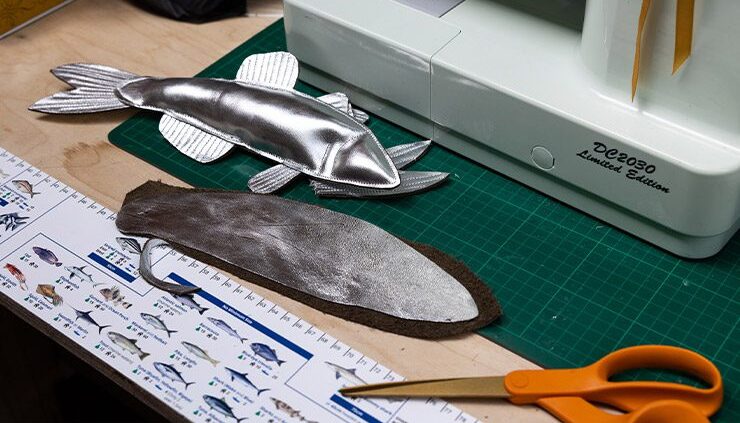
For some of my works, I use a beautiful green sewing machine, gifted to me by my father, but my favourite way of working with textiles is to hand sew. Hand sewing is a slow process; it is meditative and intimate. I can get into a real rhythm, intuitively feeling my way around an organically shaped object with a needle and thread. Sometimes the gesture is so steadily a part of me that I find my eyes drifting away from the work in my hands, while I continue to sew.