In Conversation in with Tessa Blazey
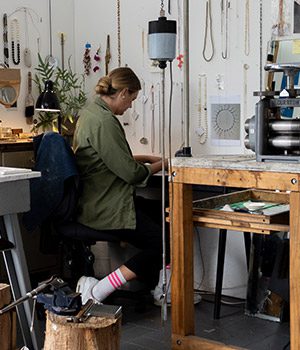
In this conversation with Tessa Blazey, e.g.etal’s newest artist, joins us to share the stories behind her new collection, ‘True Romance’. Often inspired by films that linger in her memory, translating cinema into wearable art has become a cornerstone of her creative process. Drawing from elements such as costuming, set design, characters, and colour, each piece reimagines a distinctive aspect of a film. Here, Tessa takes us through the beauty and individuality behind each creation.

‘True Romance’ takes its title from a film, and film is central to much of your practice. Can you tell us about your relationship with cinema, and how particular films come to inspire a piece?
I’ve always found great films to be an enchanting and wondrous escape into other worlds. Films seem to possess this magical ability to transport us through an intricately crafted recipe, composed of hundreds of elements. From 2001: A Space Odyssey to Stalker to The Zone of Interest, I’ve, many times over, been moved, challenged and changed by these artistically boundless forms of storytelling.
I especially love watching films in the cinema; an environment dedicated to immersing you into the world that’s been forged on screen. The vast, darkened room, big screen and surrounded sound, all pulling their weight to give you and your fellow viewers a truly special experience.
My appreciation for film grew while studying Interior Design, where I found myself particularly drawn to Production Design for Film, so much so that it became one of my favourite subjects I designed and built sets for student films and music videos.
In 2013, I held a solo exhibition titled ‘Romancing the Stone’. Each ring in the collection was inspired by one of my favourite characters from film, television, literature, mythology or anime. That was the beginning of a strong connection between my design practice and storytelling. The exhibition’s title also played on my love of gems and mineral specimens—another source of fascination and creative fuel.
To experience being fully immersed in a film, in the world, the story, the characters, the relationships, is one of life’s greatest pleasures.
Further to this, do you draw inspiration from other places such as literature, music or poetry?
I’ve always been a little obsessed with reading fiction, so my love of fictional films feels like a natural extension of that. Most of my favourite books are brilliant at immersive world-building—stories that completely draw you into their worlds. Some standouts include Oryx & Crake, Kafka on the Shore, The Corrections, The Goldfinch, A Wizard of Earthsea, The Trial, The Left Hand of Darkness, The Road, Dracula, Station Eleven and Tomorrow, and Tomorrow, and Tomorrow.
Music isn’t a direct influence on my work, but I find it almost impossible to make jewellery without it playing in the background. It creates a rhythm that helps everything flow more naturally in the studio.
Poetry, on the other hand, has never really resonated with me in the same way.
You’ve listed films as reference points, ranging from Mulholland Drive to In the Mood for Love to Brokeback Mountain. How do you approach the process of distilling the essence of a film into a piece of jewellery?
I usually begin by selecting the gemstone—or gemstones—as the very first step. From there, I choose a film still that captures a poignant moment in the narrative and print it out as a reference. I reflect on the feeling and mood of the film: its atmosphere, colour palette, and the visual language of both the production and costume design. All of these become clues that help guide the creative direction.
Sometimes, the film poster perfectly encapsulates these elements, offering a distilled summary of tone, emotion, and aesthetic. The colour and cut of the gemstone then begin to symbolise these ideas. For example, a romantic or tender story may call for soft pastel-coloured stones, with round or oval cuts that suggest innocence and femininity. In contrast, sharper, more geometric cuts—like Asscher, princess, emerald, or freeform—can reflect harsher, more brutal realities within a film’s themes or characters. Rich, saturated colours often speak to emotional or narrative intensity.
I also consider the setting of the film—whether it’s rustic, urban, fantastical, or dystopian. If a film carries a dark or menacing undertone, I might choose to set the gemstone in pointed talon claws, which evoke a sense of tension or danger.
Your works are crafted through the lost-wax casting process, using experimental forms of sculpting and carving techniques. What is it about wax as a medium that draws you to it?
I love the elasticity and plasticity of wax—you can build it up and carve it back endlessly to discover almost any form. It’s such a playful and forgiving material to work with. You can spend hours constructing a tricky, intricate shape, only to accidentally overheat it and watch it collapse into a puddle. But usually, when you start again, you’ve learned a better way to approach the structure, and the technique becomes second nature.
I’m especially drawn to the truly organic forms that can emerge through wax modelling. When I studied and practised sculpture at RMIT many moons ago, I built large-scale plaster moulds and cast objects in pastel-coloured wax. I’ve loved the material ever since—even the smell of it when it melts. There’s also something quite magical about the transformative nature of the casting process.
How do you balance creative exploration with precision in the making process, especially when the outcome will become such a significant object in someone’s life?
I hope that each of my pieces has a personality all its own. None of them are perfect—they’re handmade and carry the marks and idiosyncrasies of my making process. But I see that as a strength. It makes them more unique, more human in their final form.
I love to play and experiment with shape and structure. After nearly 18 years of making jewellery, I’ve developed a strong intuitive sense of what will work—and what won’t—on a structural level. That said, I still enjoy pushing those boundaries. Some of my more experimental cocktail rings, especially the large-scale, gem-encrusted ones, have really tested the limits of what’s possible, and that’s part of the thrill.
Could you tell us about the gemstones you’ve chosen to feature in this collection and how they speak to the stories or moods behind the works?
The gemstones chosen for this collection include a carefully curated selection of mostly Australian, Montana, and Sri Lankan sapphires, in both parti and soft pastel tones. These are complemented by a range of distinctive diamonds: an Australian champagne Asscher-cut Argyle diamond, a rough Australian diamond octahedron, a round salt-and-pepper diamond, and a rose-cut black diamond.
The collection also features several aquamarines, including a fancy cut, a princess cut, and a striking large emerald cut. Two ethereal oval brilliant-cut stones—a moonstone and a Mexican fire opal—add a dreamlike quality to the mix, their luminous, shifting colours perfectly suited to the cinematic narratives woven through the collection.
Many of these films are celebrated love stories, but often they’re also bittersweet and nuanced. How does that complexity translate into your designs?
Some of the films I draw inspiration from are quite complex—blending innocence with corruption, kindness with brutality, beauty with the grotesque. I try to reflect these contradictions in the rings and pendants that respond to such layered narratives.
A strong example of this is the piece I created in response to The Princess Bride. I chose a beautiful, ethereal Mexican fire opal and set it into a pendant for a necklace. The film has a whimsical, campy fantasy element, and I felt this opal—with its luminous, otherworldly glow—was a fitting symbol for romantic fantasy.
However, darker forces are at work in the story, threatening the Princess and her ‘one true love.’ To capture that underlying tension, I designed the setting with wild, organic, almost menacing talon-like claws gripping the stone. This juxtaposition between the delicate opal and its fierce setting speaks to the contrast at the heart of the film—love and danger intertwined.
You’ve mentioned In the Mood for Love as a piece you’re especially excited about. What about this film in particular resonates with you and how has it shaped the design of this piece?
This film is always such a pleasure for me to revisit. Its narrative and pace are utterly dreamy. The cinematography is exquisite, as are the production and costume design. Set in 1960s British Hong Kong, every scene is saturated with colour and texture—it’s an aesthetic triumph in world-building.
The surface of this ring is heavily textured to echo that richness. I selected a freeform parti sapphire with shifting shades of yellow and green tones that appear repeatedly throughout the film’s interiors and wardrobe. The stone’s dynamic interior and irregular shape reflect the emotional turbulence experienced by the two main characters, who discover their partners are having an affair with each other. Both feel isolated, rejected, and trapped in unhappy relationships. I set the sapphire in sharp talon claws to express that tension and vulnerability.
As the characters begin to spend more time together, a quiet intimacy grows between them. Their connection deepens into longing and, eventually, love. To symbolise this blossoming romance, I added a tiny red octahedral spinel—its vibrant hue and soft, rounded claws speak to the tenderness and nurturing energy of their bond.
Wedding and engagement jewellery is usually often expected to symbolise permanence and certainty. In your experience, does referencing film complicate or expand that symbolism?
I hope my work expands on that symbolism. There’s no such thing as a perfect person or a perfect relationship—but I do believe certain people can be perfect for each other. Life is chaotic, and so much of it is beyond our control. It’s how a couple weathers that chaos together that can create real strength and a sense of security in a relationship.
I think almost all of the films in this exhibition speak to that idea. Each one explores tension, conflict, or struggle—but also connection, growth, and love. A film without tension would be dull to watch. I feel the same way about life and relationships: it’s the imperfections, the challenges, and the emotional vulnerability that make them meaningful.
What can we expect when encountering ‘True Romance’ as an exhibition?
I hope the exhibition offers a delightful and engaging experience for those who see it. Many people will likely have a deep emotional connection to some of the films I’m referencing through these new jewels, and I hope they can feel the link between the cinematic moments and the pieces I’ve created.
To bring the display to life, I’ve collaborated with my dear and brilliant friend Kate Rohde, who has created a series of sculptural props and settings to showcase the work. One of the films, Dr Zhivago, features an unforgettable scene where the two main characters return to a grand, abandoned house filled with snow and glistening icicles—an utterly breathtaking setting. I asked Kate to interpret this atmosphere by making delicate, transparent pale blue icicle clusters in her signature resin. The first one she’s created is exquisite—it looks like a fantastical ice castle.
These ephemeral, dreamlike displays paired with the warmth of yellow gold and a rainbow of gemstones will, I hope, create a visual experience filled with wonder.
When people wear your pieces, they’re carrying not only precious materials but also layered stories and references. What do you most hope wearers resonate with or carry with them when wearing your pieces?
When people wear my pieces, I hope they carry with them a sense of emotional resonance—both personal and shared. Each work is rooted in layered storytelling, often drawn from deeply atmospheric and emotionally complex films. These cinematic references aren’t always immediately visible, but they inform the mood, material choices, colours, and forms. I hope wearers feel that embedded meaning.
My pieces are about more than aesthetics—they’re about connection: to memory, to longing, to strength, vulnerability, fantasy, and transformation. Life and relationships are never perfect, just as my handmade pieces carry their own idiosyncrasies. But that’s what makes them human. I want wearers to feel that these jewels reflect something real—about themselves, or about what they’ve lived, loved, or endured.
Each gemstone is carefully chosen to symbolise a particular emotional tone or narrative moment. The settings—whether tender and soft or wild and sharp—mirror those emotional textures. I hope the wearer feels like they’re carrying a small, wearable world with them; a quiet talisman of their own story, filtered through mine.
Ultimately, I want the experience to be joyful, cinematic, and deeply personal.